The Bottom Line
The shift from "prompting" to "context engineering" defines modern AI usage. Research shows well-structured prompts improve LLM performance by 20-40% on benchmarks. But here's the surprise: 150-300 words is optimal for most tasks, with degradation starting at 3,000 tokens.
Modern reasoning models (GPT-5, Claude 4, Gemini 3) require fundamentally different approaches than their predecessors. They follow instructions literally, think internally by default, and can be harmed by traditional chain-of-thought prompting.
The three major AI labs have converged on similar structural recommendations: role/identity first, then instructions, followed by examples, context, and output format specifications last.
Seven Essential Components Every Prompt Needs
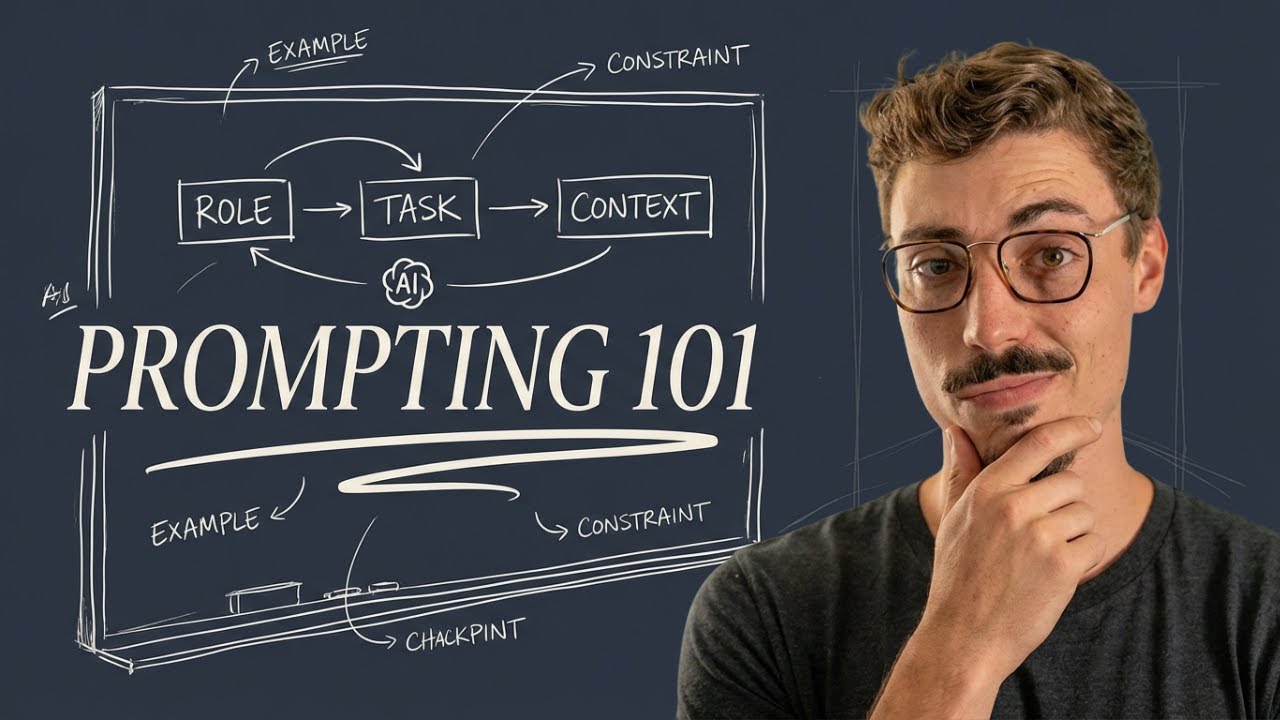
The consensus across Anthropic, OpenAI, and Google identifies seven core elements that determine output quality:
| Component | Purpose | Example |
|---|---|---|
| Role/Persona | Activates domain-specific knowledge | "You are a senior data scientist at a Fortune 500 company" |
| Task Context | Background and audience info | "Results will be presented to the board" |
| Clear Instructions | The core request | "Summarize in 3 bullet points" |
| Sequential Steps | Ensures exact execution order | Numbered list of actions |
| Few-shot Examples | Demonstrate expected format | 3-5 diverse, relevant examples |
| Output Format | Expected response structure | "Return as JSON with these fields..." |
| Constraints | Narrow the output space | "Under 200 words, no jargon" |
The golden rule from Anthropic: "Show your prompt to a colleague with minimal context on the task. If they're confused, the model will likely be too."
This principle applies universally across all models.
Framework Comparison: Anthropic vs OpenAI vs Google
The major AI labs have converged on remarkably similar structural recommendations, but with model-specific nuances that matter.
Anthropic's Approach for Claude
Claude 4.x models take instructions literally. Earlier versions would infer intent and expand on vague requests—now you must be explicit about desired behaviors.
Anthropic recommends these techniques from most to least broadly effective:
- Be clear and direct
- Use examples (multishot prompting)
- Let Claude think (chain-of-thought)
- Use XML tags for structure
- Give Claude a role via system prompts
- Prefill responses to guide format
- Chain complex prompts
- Apply long context tips
Key insight: Extended thinking scores 10/10 for complex reasoning but only 3/10 for simple queries where it adds unnecessary overhead. Claude Opus 4.5 is also "particularly sensitive to the word 'think'" when extended thinking is disabled—substitute with "consider," "believe," or "evaluate."
OpenAI's Structure for GPT Models
GPT-4.1 and GPT-5 have a 1M token context window but respond best to explicit, specific prompts. Conflicting instructions are particularly damaging—the model wastes reasoning tokens trying to reconcile conflicts.
OpenAI's recommended order: role and objective first, then instructions (with sub-categories for tool calling and formatting), reasoning steps, output format, examples, context, and final instructions.
For agentic tasks, three components increased SWE-bench scores by ~20%:
- Persistence (keep going until resolved)
- Tool-calling guidance
- Planning requirements
Critical for reasoning models (o-series, GPT-5): Avoid chain-of-thought prompting. These models reason internally, and prompting them to "think step by step" is unnecessary and can actually hinder performance.
Google's Gemini Approach
Gemini 3 models no longer require complex prompt engineering like chain-of-thought forcing. If you used elaborate techniques for Gemini 2.5, try simplified prompts with thinking_level: "high" instead—the model may over-analyze verbose prompt engineering techniques.
Google recommends XML-style tags or Markdown headings as clear delimiters. Place context and source material first, main task instructions in the middle, and formatting constraints last.
Critical setting: Keep temperature at 1.0—lowering it can cause loops and degraded performance in reasoning tasks.
| Feature | Claude 4.x | GPT-4.1/5 | Gemini 3 |
|---|---|---|---|
| Instruction following | Very literal | Surgical | Literal, simplified |
| CoT prompting | Beneficial (non-extended) | Avoid for o-series | Unnecessary |
| Preferred delimiters | XML tags | Markdown/XML | XML/Markdown |
| Context window | 200K+ | 1M tokens | 128K-2M |
| Key parameter | Extended thinking | reasoning_effort | thinking_level |
The Prompt Length Research (This Will Surprise You)
Multiple 2024-2025 studies confirm: longer is not better.
Research by Levy et al. found LLMs "quickly degrade in reasoning capabilities even at 3,000 tokens—well before technical maximum context windows." TryChroma's "context rot" research confirms that as token count increases, accurate recall decreases.
Optimal Length by Task Type
| Task Complexity | Optimal Length | When to Use |
|---|---|---|
| Simple (summaries, Q&A) | 50-100 words | Translations, basic questions |
| Moderate (content creation) | 150-300 words | Writing, analysis, professional work |
| Complex (technical docs) | 300-500 words + chaining | Multi-step workflows, strategic analysis |
The key finding: A well-structured 16K-token prompt with retrieval augmentation outperformed a 128K-token prompt in both accuracy and relevance. Strategic selection of high-signal information trumps comprehensive inclusion.
Why Does Length Hurt Performance?
Several factors explain the degradation:
- Recency bias: Transformers weight recent tokens more heavily—critical information early in long prompts gets undervalued
- Hallucination rates increase dramatically with length
- Latency: Every 500 tokens adds ~25ms response time
- Signal dilution: LLMs can identify irrelevant details but struggle to ignore them
Three Frameworks for Different Situations
Not every task requires elaborate prompt engineering. Here's which framework to use when:
APE Framework (Simple Tasks)
Action, Purpose, Expectation
"Summarize this article in three sentences for a busy executive."
Covers ~80% of straightforward tasks. Adding unnecessary structure to simple tasks can actually degrade performance, as modern models may over-analyze verbose prompting.
CO-STAR Framework (Content Creation)
Context, Objective, Style, Tone, Audience, Response
Best for writing tasks where voice, format, and audience matter. Example:
# CONTEXT
I'm writing a mystery novel set in 1920s Chicago during Prohibition

# OBJECTIVE
Write the opening paragraph that hooks readers

# STYLE
Noir fiction, similar to Raymond Chandler

# TONE
Atmospheric, ominous, with dry wit

# AUDIENCE
Adult fiction readers who enjoy classic noir

# RESPONSE
150-200 word opening paragraph
The explicit separation prevents the model from conflating different aspects of the request.
RISEN Framework (Complex Multi-Step)
Role, Instructions, Steps, End Goal, Narrowing
Use for analysis, strategic tasks, and workflows requiring systematic approaches:
Role: Senior data analyst with expertise in customer segmentation

Instructions: Analyze the provided customer dataset to identify distinct segments

Steps:
1. Identify patterns in purchase behavior
2. Group customers by similar characteristics
3. Name each segment descriptively
4. Recommend marketing strategies per segment

End Goal: Actionable report for marketing team to improve targeting

Narrowing: Focus on customers with 6+ month purchase history, exclude outliers
The end goal aligns output with business needs rather than academic exploration. Constraints (budget, timeline, scope) make recommendations immediately actionable.
Overlooked Techniques That Actually Work
Several prompt components are routinely underutilized despite substantial impact:
Output Anchoring
Start the response for the model. Prefilling with "The three key points are: 1." guides the model into the exact structure you want. Anthropic explicitly recommends this technique, and it works across all major models.
Delimiter and Structural Markers
The Prompt Report (Schulhoff et al., 2024) found that minor formatting modifications—reordering examples, adding whitespace, using delimiters like ### or === or XML tags—can change accuracy by 30%+.
Context Placement Strategy
For long documents, place instructions at the end of prompts, after the context material. Use anchor phrases like "Based on the entire document above..." to refocus attention.
Calibrated Confidence Prompting
Ask the model to rate confidence 1-10 and explain uncertainties. Produces more reliable outputs for accuracy-critical applications but rarely implemented.
Emotional Tone Framing
"Explain to a 5-year-old" versus "Explain to an investor" produces dramatically different responses for identical content—the framing activates different communication modes and vocabulary levels.
What the Research Actually Shows
The Prompt Report (Schulhoff et al., 2024) systematically reviewed 1,565 papers and identified 58 text-based prompting techniques. Key findings:
Chain-of-thought has diminishing returns. A June 2025 Wharton study found that for reasoning models (o3-mini, o4-mini, Gemini Flash 2.5), CoT benefits are minimal (+2.9% to +3.1%) while adding 20-80% more time. For non-reasoning models, improvements vary: Claude Sonnet 3.5 (+11.7%), GPT-4o-mini (+4.4%, not statistically significant).
Few-shot versus zero-shot is nuanced. For reasoning-heavy tasks, zero-shot CoT ("Let's think step by step") often outperforms few-shot because the model can generate logical paths without being constrained by potentially unrepresentative examples.
Consensus findings across 2024-2026 research:
- Prompt engineering improves performance by 20-40% on benchmarks
- Exemplar selection matters more than quantity—diversity is critical
- Shorter is often better (150-300 words optimal)
- Structure (numbered lists, bullet points, delimiters) improves consistency
- Modern models often think by default; explicitly requesting "direct answers" can harm performance
Action Steps: Start Here
If You're Using AI Occasionally
Start with the APE framework. Action + Purpose + Expectation covers most needs without complexity. Don't overcomplicate simple tasks.
If You're Creating Content Regularly
Use CO-STAR for writing tasks. The explicit style/tone/audience separation produces noticeably better results than unstructured prompts.
If You're Building Automations
Structure prompts with RISEN. Include explicit steps, end goals, and constraints. Test with the specific model you'll deploy—a prompt optimized for Claude 3.5 may actively harm performance on Claude 4.
For All Use Cases
- Keep prompts under 300 words when possible
- Use numbered steps for multi-part tasks
- Put format specifications at the end
- Include 3-5 diverse examples for new task types
- Test your prompts across the specific model you'll use in production
The Future: Context Engineering
The field has matured from simple "prompt engineering" into what Anthropic now calls "context engineering"—the discipline of curating optimal token sets across system prompts, tools, external data, and message history.
The guiding principle: Find the smallest possible set of high-signal tokens that maximize the likelihood of desired outcomes.
The best prompt is not the most elaborate—it's the one that achieves your outcome with the minimum necessary context.
Building AI automations for your business? Book a strategy call and we'll design prompts optimized for your specific workflows.